
Boost Your SEO with Markup: A Guide to
Structured Data
As a website
owner, you’re constantly looking for ways to improve your search engine
rankings and drive more traffic to your site. One often-overlooked but powerful
tool in your SEO arsenal is markup. In this blog, we’ll explore the various
types of schema markup used for SEO and how they can help you stand out in
search results.
What is Markup?
Markup is a way to
add structured data to your website’s HTML, providing search engines with
additional context about your content. This can include information like
business hours, reviews, and events, which can be displayed directly in search
results.
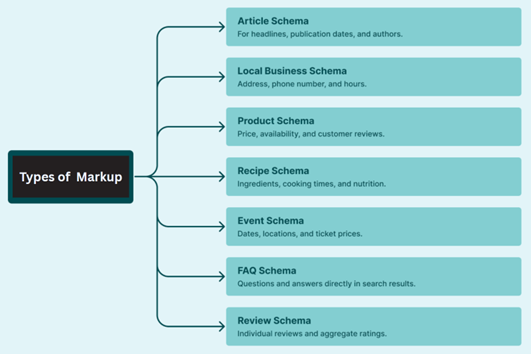
Types of Markup:
Schema.org
MarkupSchema.org is a collaborative project between Google, Bing, and Yahoo
that provides a standardized vocabulary for structured data. It’s the most
widely used type of markup and supports a wide range of content types,
including:
– Organization
– Person
– Place
– Event
– Product
– Review
– Recipe
Example:
{
"@context":
"https://schema.org/",
"@type": "Organization",
"name": "Example Inc.",
"url":
"https://example.com",
"logo":
"https://example.com/logo.png"
}
Open Graph Protocol (OGP)
MarkupOpen Graph
Protocol is a markup language used to control how content is displayed when
shared on social media platforms like Facebook and Twitter.
– Types: og:title, og:description, og:image, og:url
– Format: Meta tags
Example:
<meta property="og:title" content="Example
Inc." />
<meta property="og:description"
content="This is an example organization." />
<meta property="og:image"
content="https://example.com/image.jpg" />
Twitter Cards Markup
Twitter Cards are
a type of markup that enhances tweets with images, videos, and other media.
– Types: Summary, Summary Large Image, App, Player
– Format: Meta tags
Example:
<meta name="twitter:card"
content="summary" />
<meta name="twitter:site"
content="@example" />
<meta name="twitter:title"
content="Example Inc." />
JSON-LD Markup
JSON-LD is a
lightweight data interchange format that’s easy to read and write.
– Types: Organization, Person, Place, Event, Product, Review
– Format: JSON-LD script tags
Example:
{
"@context":
"https://schema.org/",
"@type": "Organization",
"name": "Example Inc.",
"url":
"https://example.com"
}
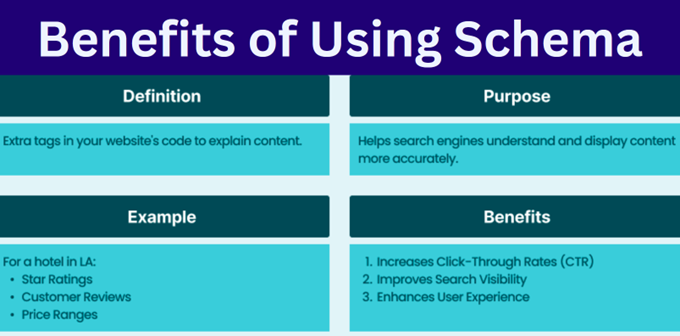
Benefits of Markup:
Improved Search
Results: Enhances search snippets with additional information
– Increased Click-Through Rate (CTR): Makes search results
more attractive and informative
– Better Content Understanding: Helps search engines
understand content context and relevance
Best Practices:
Use Schema.org
Vocabulary: Use standardized vocabulary for markup
– Test and Validate: Test markup with Google’s Structured
Data Testing Tool
– Keep it Up-to-Date: Regularly update and maintain markup
as content changes
By implementing
these markup types and following best practices, you can improve your website’s
visibility, drive more traffic, and increase engagement. Start boosting your
SEO with markup today!
At Clarifu
Infotech, we specialize in helping businesses like yours succeed online. Our
team of experts can help you implement markup and other SEO strategies to
improve your search engine rankings and drive more traffic to your site.
Contact us today to learn more about how we can help you achieve your online
goals.